Good day everyone,
I have been using a Fuse 1+ with great satisfaction for just over a year and, like most users, I bought the material recommended by our reseller: standard Nylon PA12.
Recently, customer demand has been growing, also thanks to the fact that we provide a full service including 3D scanning, 3D design, and part customization through laser marking.
A few months after our initial purchase, Formlabs introduced Nylon PA12 White and Nylon PA12 Tough.
The White version provides a light base that is useful for dyeing parts in other colors, but the required use of inert gas (nitrogen) to prevent yellowing over time, together with longer production times (due to the natural light refraction of white powder), makes it somewhat less attractive for our workflow.
From a cost-optimization perspective, especially for a small business like ours, the Tough version seems more interesting on paper: it has a lower base cost, a 20% refresh rate, improved ductility and better dimensional accuracy.
According to the comparison table, it also appears to offer other advantages over standard PA12. However, I still have some doubts regarding print speed and surface quality.
I haven’t been able to find clear information online about these aspects, nor detailed images showing a direct comparison between the two materials, ideally printed as the same part.

I did receive the official Formlabs demo sample, but I would really like to see additional real-world parts printed in Nylon PA12 Tough, in detail.
In our lab, we use the Fuse Blast with the polishing kit, so I’m also wondering whether any potential surface defects could be easily mitigated through blasting and polishing.
Another important concern relates to mechanical performance, specifically HDT.
For Nylon PA12 Tough, the HDT is listed at 46 °C, compared to 87 °C for standard PA12—almost double.
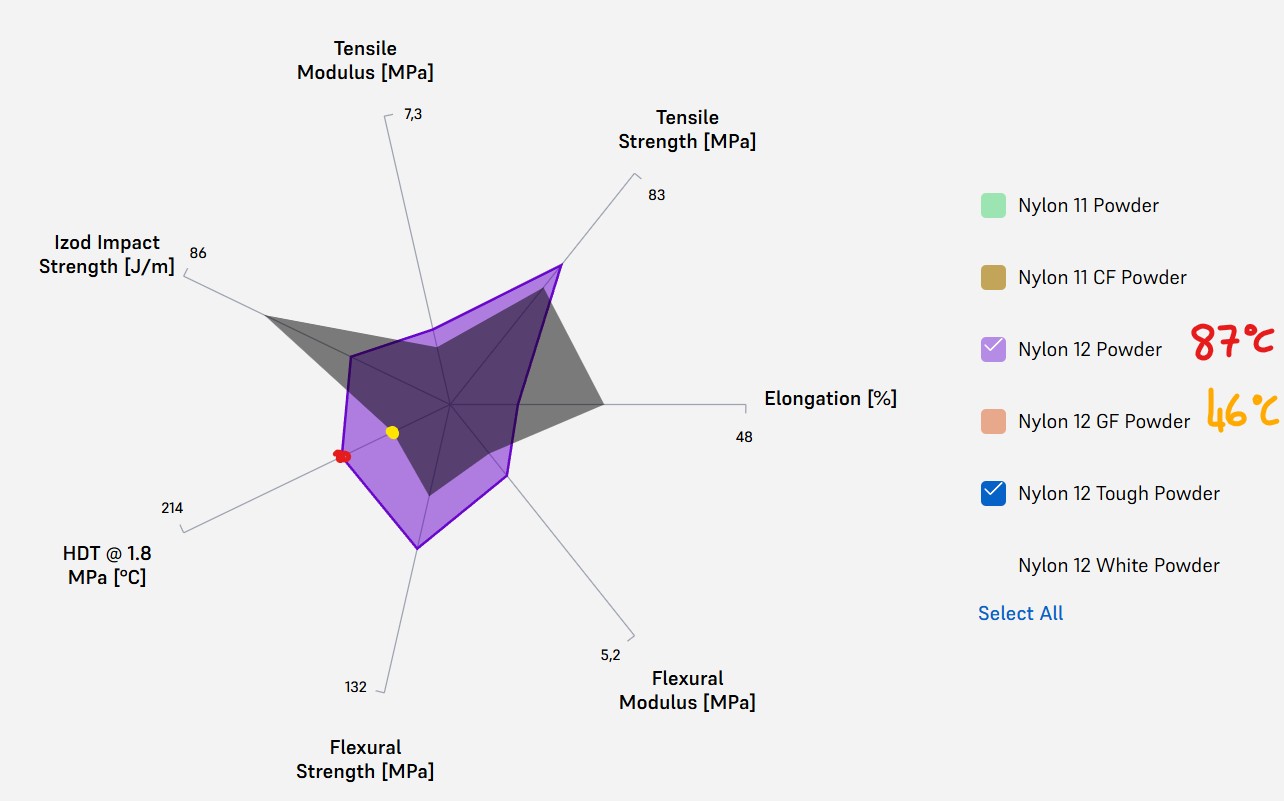
Since these values are derived from standardized test specimens, I unfortunately don’t yet have enough practical experience to fully interpret what this difference means in real-world applications.
With Tough at 46 °C (for example, on a hot sunny summer day), could I experience mechanical issues that I wouldn’t have with standard PA12?
Could this limit its use in outdoor applications or near heat sources?
I tried asking both our supplier and a local printing service whether it would be possible to print some of our parts using Nylon PA12 Tough, but at the moment they do not have this material loaded in their Fuse 1+ systems.
Following a suggestion from Formlabs, I also written to the contact person for Italy, but unfortunately they do not offer this type of service.
Even the Formlabs site that appears to be about to become operational (https://now.formlabs.com/) does not list Tough as an available option, and it may not be active in other countries yet (I am in Italy).
At this point, having no other sources to rely on, I would kindly ask the community whether anyone is already using Nylon PA12 Tough, for which applications, and whether they could share meaningful images or feedback regarding surface quality.
Since I need to decide very soon on the purchase of the next 50 kg bulk, I find myself at a crossroads:
should I stay with standard PA12, or switch to Tough, which seems to offer some performance advantages while also reducing operating costs?
Reference:
https://formlabs.com/store/materials/nylon-12-tough-powder/
