We are experimenting with tinting the Rigid10k resin. While the parts work great, the white color is not, ideally we’d have a darker grey or even black. After a chat with tech support at Formlabs we purchased a black alcohol ink and printed parts with different amounts of ink added to the resin. Despite the resin in the tank getting progressively darker the parts themselves only took on a very subtle grey color when dry (when wet with IPA they look much darker). Knowing the Rigid10k resin has a powdery surface finish we tried washing them in fresh IPA and later deionized water. Neither had any effect. We read an older post that suggested rubbing the surface with mineral oil. That too had no effect. We then took a very fine grit sand paper to each part and just under the surface we found the parts did in fact have progressively darker colors. Exactly what we were going for. So we are able to get the color we need, but we have no way to reveal it since sanding the parts completely is not possible. Is there really no way to remove the powdery white surface on Rigid10k parts, that is simple? I did read an article suggesting a mild sand blasting but that is not practical as we do not have equipment for that.
@cdk007 I have the same problem, I have a lot of Rigid 10K applications and demands, but the color is always a complaint of my customers. If possible, could you share some pictures of your experiments? Tks
You could try a light bead blast or using a vibratory tumbler with a very light compound (I believe walnut shells are sometimes used?). Easiest way I can think off to remove a very thin layer uniformly that is not by hand.
I was able to rub it off flat surfaces with nitrile gloves and fresh IPA, but I have no solution for tight corners and such.
I lightly sandblasted some parts in the past, it does work, but knocks off any sharp edges, which wasn’t preferred for us.
Hi @cdk007, thanks for detailing your issue! If dyeing the resin not achieving the desired outcome, another option would be a spray paint or dip dye of the printed parts. However, achieving consistent results is going to be more difficult with this material unfortunately, due to the filler Rigid 10K Resin contains.
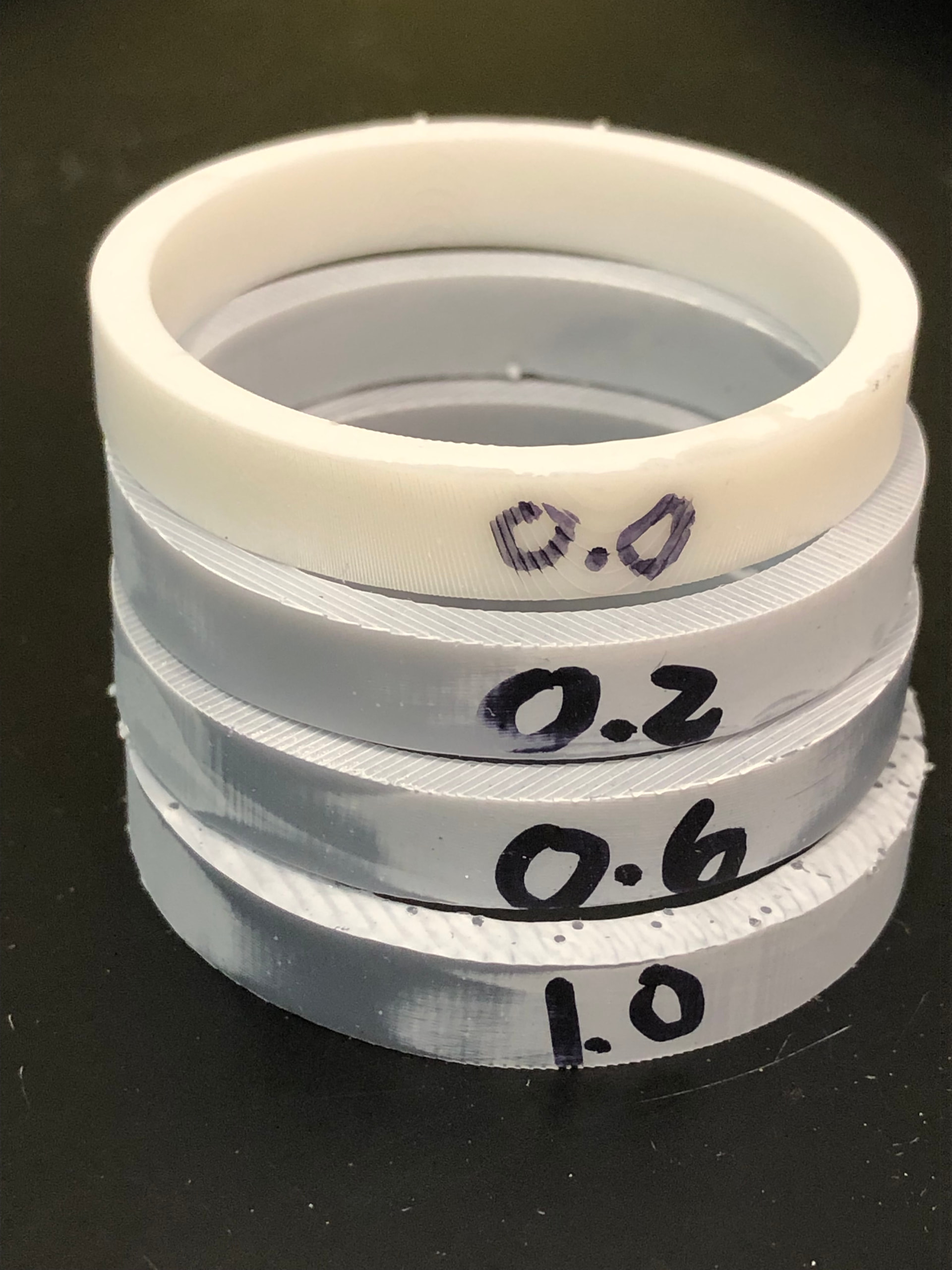
Here is a photo of the same part printed with different amounts of ink added to the resin tank (0, 0.2, 0.6, and 1.0 ml). I’ve sanded a small section of each part to the left of the numbers. As you can see even a small amount of ink results in a tint to the part, but adding more ink does not alter the surface color (it is always a light grey). However, more ink does result in a darker core color to the part, which is exactly the color we were looking for, but there is no way to reveal that color without removing the surface layer. Rubbing with a glove (as kindly suggested) did not work for us. Here I lightly sanded each part since we do not have access to any type of sand blasting or vibratory polishing equipment. I would be great if there was some type of wash or print setting that could reveal the core color of the parts since anything else will generally not be able to access tiny crevices or be readily available to most users.
I posted a photo with description below.
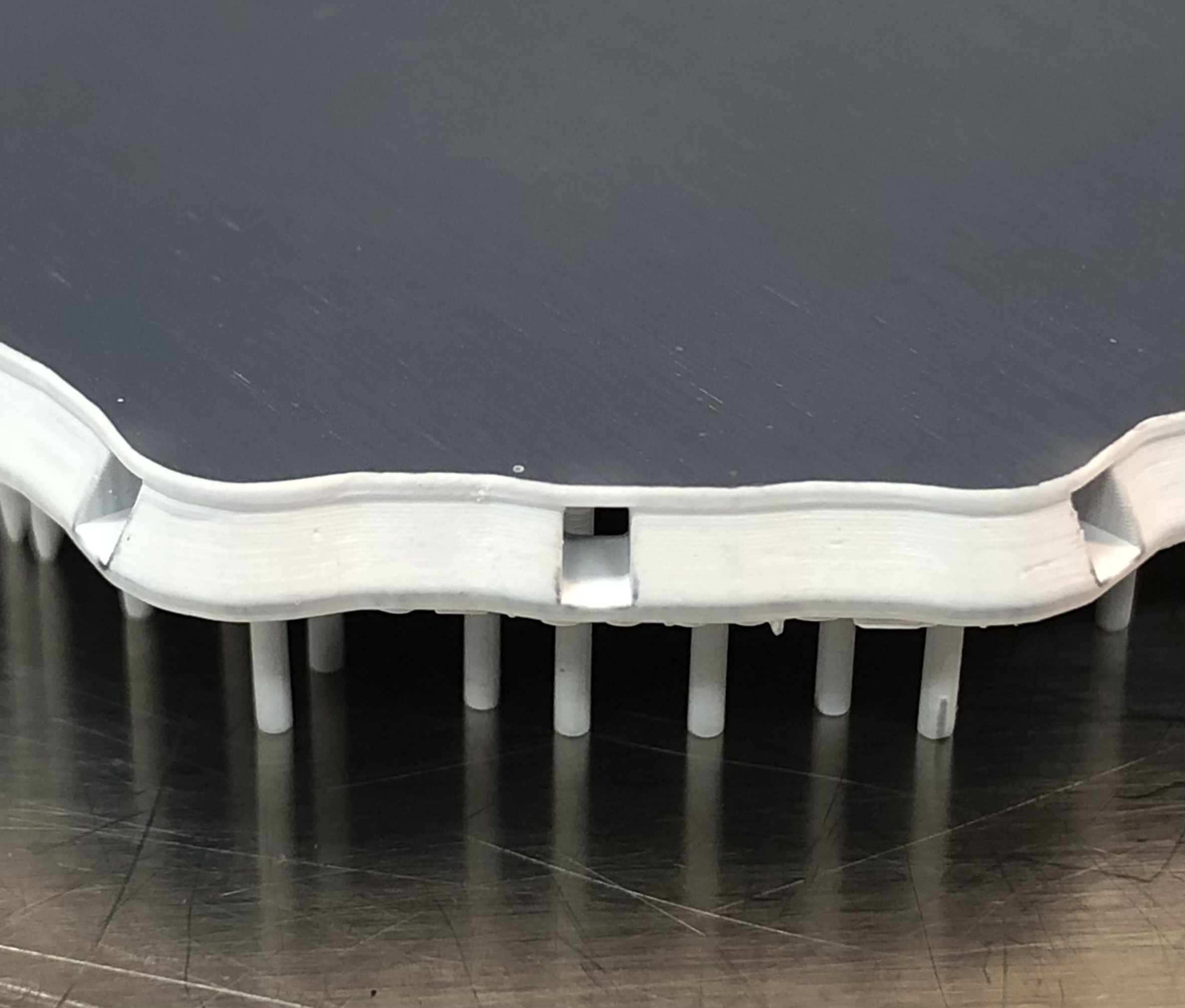
I also wanted to post a few photos that I think get at the problem we’re having with tinting this resin. Here I’m showing the raft and supports from a recent print with the most amount of ink in the resin. As you can see when we zoom into a snapped support only the outer few 10s of microns takes on the white powdery color (scale is 1mm ticks on a ruler). The core of the support is dark. Looking at the topside of the raft (the side not attached to the build platform) it also has a darker color compared to the sides of the supports. Lastly the underside of the raft, the side attached to the build platform, shows the true dark color, i.e. what we see when sanding down other surfaces. Therefore, the white powdery surface only seems to adhere to faces that are not parallel to the build platform, and is only a few 10s of microns thick.