More motorcycle parts, this time in Black V5

Compared to my previous resin printing experience, I continue to be impressed by the FormLabs ecosystem of resins, even the general purpose ones.

I’m preparing to ride one of my electric motorcycles through Big Bend National Park in Texas next month. This will be 5 days through some pretty rugged terrain of rock, sand, and gravel. One of my motorcycles was in desperate need of a fender extender to keep the front tire from slinging sand and gravel particles up in my face. So I got to work in Fusion360 and started running prototype prints on my Form4 using Black V5. I ran several prototype prints on the bike, but I was still getting tiny particles in my face/eyes when riding. The design wasn’t quite good yet.

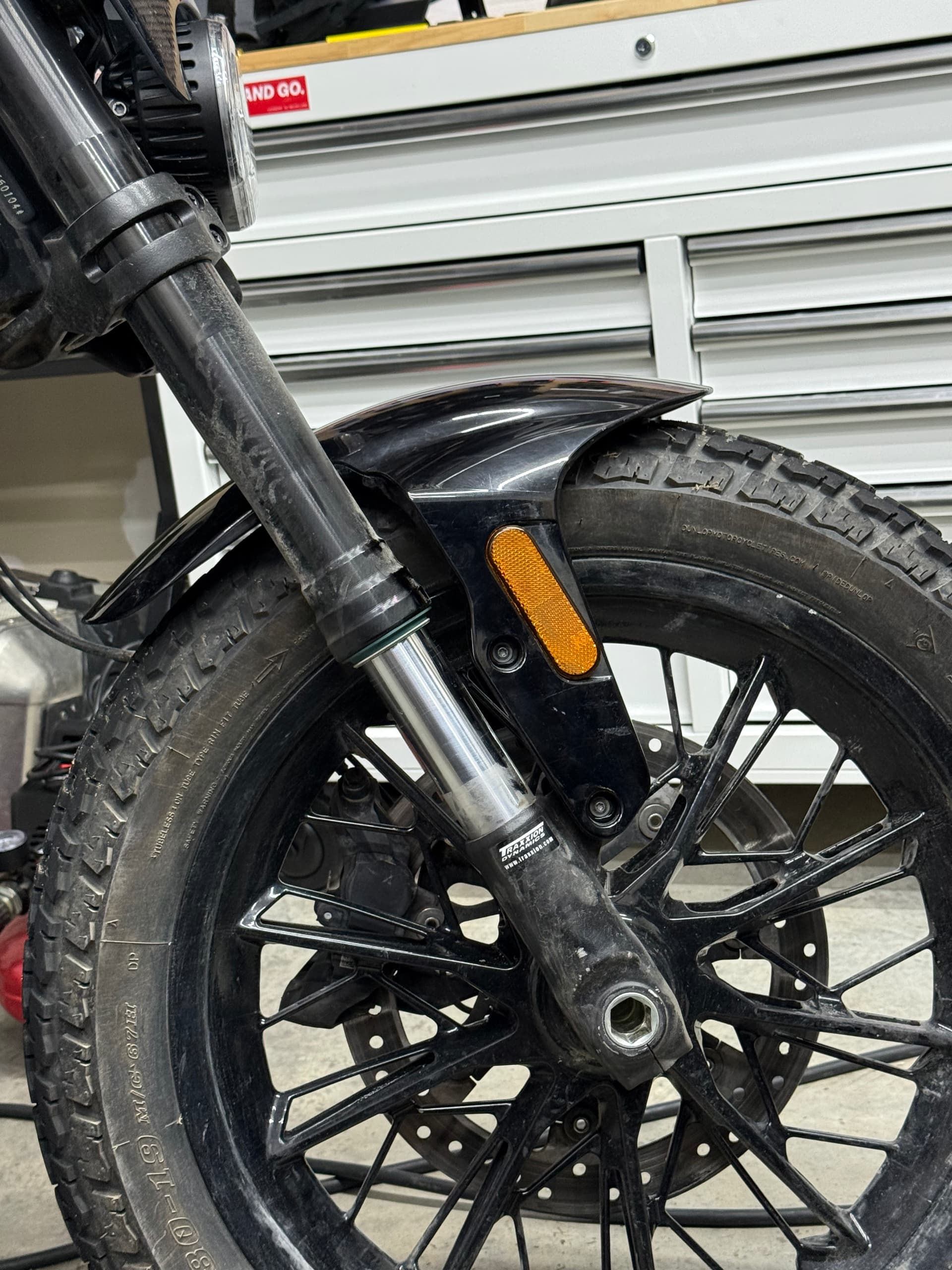
Stock fender, without extenders
I was surprised at the durability of this general purpose resin. I used 3M tape to secure the fender extender to the bike’s fender. A few times, I misaligned the position and had to pull the part off. Although some parts did break eventually from the stress of being twisted and pulled, if pulled slowly and with subtle twisting, the parts survived! Any other consumer resins would have shattered instantly.

v3 - angle was way off, but design was close

Eventually I added a small deflector on the inside of the fender extender, and that significantly reduced the amount of small particle sent airborne into my face.

lengthened and deflector added

What I’ve always loved about resin printing is the ability to iterate quickly. I was able to design and print 7 designs and prototypes within a 24 hour period. I went from having the idea one day, to riding with a functional design the very next day. If only I had such technology as a kid (beyond legos and erector sets), I probably would have been an engineer!

function design complete.

After printing two of the near final designs, I went for about a 50 mile test ride. While the design doesn’t stop every single grain from being slung up at me, there was a significant reduction. This is how the bike will be for now, as I don’t have time left to get the aesthetics where I would want them for a final-final design. Ultimately you want to have these adhere to the inside of the fender, and have the body ‘pick up’ where the original fender ended as to carry the body forward.

So we will see how Black V5 holds up to 600+ miles of bumps, jumps and hopefully no drops!

3 Likes

I’m working on a kinda similar project, how is the Black V5 holding up so far? I’m thinking about the Black V5 for testing and Tough V2 for the final part.

It’s been holding up great! probably close to 600 miles on these parts - no signs of failure ( some cosmetic dings from rocks on the underside)

2 Likes

More motorcycle parts, printed in Tough 2000 v1.1. A tank bag (storage) mount adapter. I did a few runs of different angles before getting it right, then shelled the model, added webs, split it in two, and tapped posts for threading bolts through to hold everything together. The mount features a magnetic set and lock, which stays on the bike. It’s a fantastic design, just set the bag down and it locks on its own. Pull a spring loaded tab to unlock it and remove the bag - very satisfying to use. The adapter is secured with 3M trim tape - had to break the prototype off just to remove it for the final design. I love making my own things, doubt this will turn into a product, but it was fun to figure out. This was printed at 100microns, layer lines a very visible, but it’s just a test piece. Another successful project with the Form 4!

2 Likes

This is fantastic, thank you for sharing! Do you have any issues with Tough 2000 V1.1? Curious to hear your thoughts on V2 if you end up giving it a try!

1 Like

Thanks! I’ve had great success with v1.1. I look forward to trying v2 once I get through my inventory of 1.1. I’d like to see what the performance difference is between the 2

Have you ever tried using some textures to make the layer lines less noticeable on the outside surfaces ?

I usually add some grain to mask the layer lines a bit and give the part a more finished aspect.

Even on prototype cause that help me to know the texture tool a bit better each time.

1 Like

I think I’ve tried it once, however I couldn’t get the file to act right - the scaling was always off when importing. I use Fusion360, and from what I remember it doesn’t provide the right data for color face profiles that PreForm uses. I could be wrong though. Will have to experiment with it again to see if I can get it working (it completely might be operator error).

What’s your design flow for getting textured surfaces?

I use Catia and the surface colored are recognized on preform natively.
So usually I either color the surfaces I need or I create a pocket of 0.001 mm and then color it.

Then I just use the preform texture tool with known values from my previous tests and my own displacement maps.

Pretty straight forward to be honest

2 Likes